Cape Blanco Lighthouse — The Painting That Started Because Nobody Said Anything
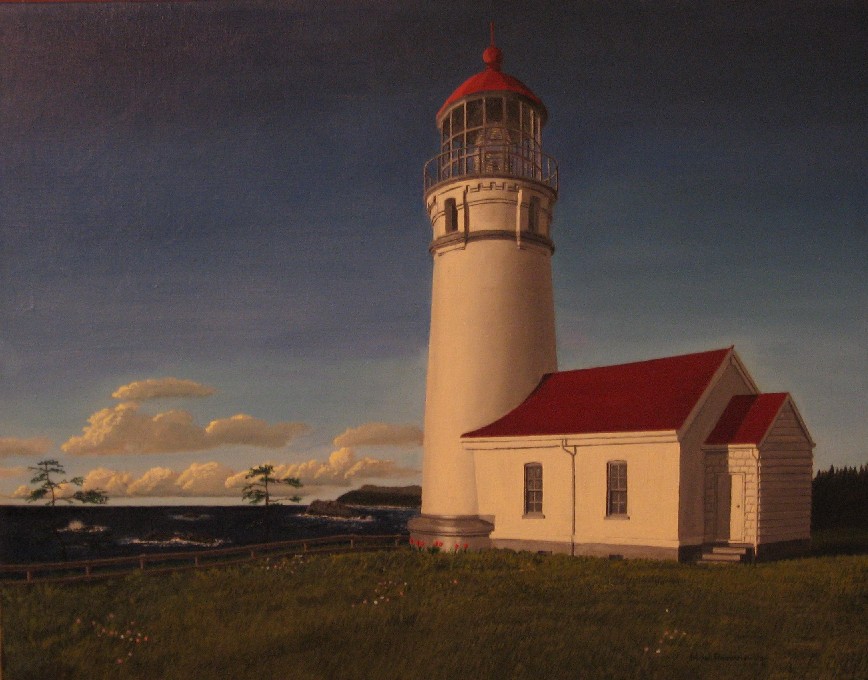
A few years ago I came across a stunning black and white photograph in a lighthouse calendar — Cape Blanco Lighthouse, perched on the Oregon coast. Something about the composition grabbed me, so I drew it. Framed it. Hung it in the dining room.
Nobody said a word.
After a few months of silence, I figured no one cared, so I gave it away. My wife immediately noticed. "I liked that drawing!" she said. So I promised her I'd do better — I'd paint the same image for her, in oil, in color.
There was just one problem. The reference photograph was black and white. I had no idea what color the roof was, what the building looked like up close, what the grass and sky actually looked like on that remote cape. So I started researching.
What I found pulled me in deeper than I expected.
Cape Blanco is the most westerly point in Oregon — a windswept cape with 200-foot chalky white cliffs that gave it its name when Spanish explorers first saw it. The lighthouse was authorized in 1867, but getting it built was an ordeal. The site was so heavily forested with spruce that most of the first three years were spent just clearing trees. There were no roads. Every piece of material had to be shipped in by sea, landed through the surf, and hauled up the cliffs. During the first supply delivery in May of 1870, a gale struck while they were unloading the ship. The ship was driven onto the beach and wrecked, cargo and all.
They made the bricks on site after that. Cheaper than losing them to the ocean.
The light was finally lit on December 20th, 1870. Its keepers lived a hard, isolated life — maintaining the lamp and lens, rescuing the shipwrecked from the rocks and pounding surf below, providing what medical care they could. Two men, James Langlois and James Hughes, spent their entire careers there — 42 and 38 years respectively — most of it working side by side. In 1903, Mable Bretherton joined them as Oregon's first woman lighthouse keeper.
All of that history was running through my mind as I worked out the colors and put brush to canvas. The red roof, the warm light on the white tower, the deep greens of the coastal grass, that moody Oregon sky. I wanted to capture what Tom Algire had captured in his photograph — that sense of a solitary structure standing firm against everything the Pacific could throw at it.
Speaking of Tom Algire — once I decided I wanted to sell prints, I knew I needed to do this right. Tom is an Ansel Adams Award-winning photographer, and that calendar image was his work. I tracked him down and purchased an artistic reference license. It was an interesting phone call.. It took me a few moments and an emailed image of the painting to convince him I wasn't some crackpot.. After I purchased the license I sent him a print. He loved it and told me it was his mantle piece, then he told me the story of how he had taken the photo.. Evidently it was quite a drive up to the lighthouse, through forested areas.. When he finally got there, in order to get a good shot he was straddling this wobbly wood fence. By the time he was done, he said it was too late to drive back so he slept in his car, with the window slightly open and fell asleep to the sounds of the surf below.
The composition in my painting is based on his photograph, used with his permission.
This was one of my earliest paintings. It taught me that the story behind a subject matters as much as the image itself — and that sometimes the best motivation comes from someone you love telling you they noticed what you made, even when you thought nobody was paying attention.
Oil on canvas. Reference photograph by Tom Algire, used under artistic reference license.